Data Logging
The Data logging utility helps you collect sensor datasets from the sensor boards with the firmware that outputs sensor data through a COM port. This section describes how to set up and collect the sensor dataset.
This utility can help program the corresponding firmware binary with a data logging function to some NXP demo boards. For other boards, implement and program the firmware beforehand using the following specific data format.
Data Format Specification:
All characters are encoded in ASCII.
Data samples are separated by any one delimiter of space, comma, tab, and semicolon.
Every line of the dataset ends with ‘\r\n’ and contains N(N>=1)*channels of samples.
To capture data from the target board connected to the PC, navigate to the Data Logging utility page.
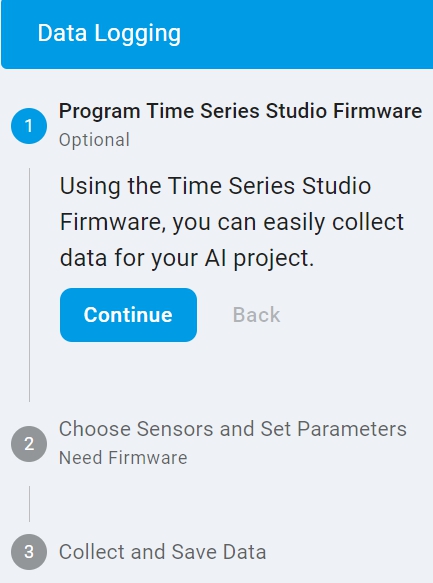
As shown above, the data logging process consists of three high-level steps. You can skip the first and second steps.
The first step supports to program the firmware binary provided by the utility to the target board. The supported boards are listed in the
Your Targetdrop-down list. If the board is unsupported or has been programmed, the step can be skipped.The second step supports to get and set the sensor parameters from/to the board that has the functions after connecting to the COM port. This step is only relevant for boards with firmware programmed in the first step. It can be skipped without the functions or requirements.
The third step supports to collect and save the sensor data from the target board after connecting the COM port. It is necessary for any board for data logging.
Program Firmware (optional)
It is supported in the first step.

Click the
Refreshbutton.Select the
Probe.Select the connected target board in the support list of the
Your Target.Click the
Programbutton to program the corresponding firmware binary.
Connect COM Port:
It is required in the second or the third step.

Click the
Refreshbutton.Select your target board COM port. For example, COM14.
Select the baud rate as supported in the list. The default is 115200.
Click the
Connectbutton and complete the board connection. After successfully connecting to the COM port in the second step, the system automatically retrieves the supported sensors, the current activated sensor and its parameters for the target board. To configure the parameters for one sensor, select the sensor by clicking on the tab with the sensor name, such as “Temperature+Accel” for multi sensors of Temperature and Accelerometer, then select a parameter from the value list and click theConfig Data Loggerbutton.
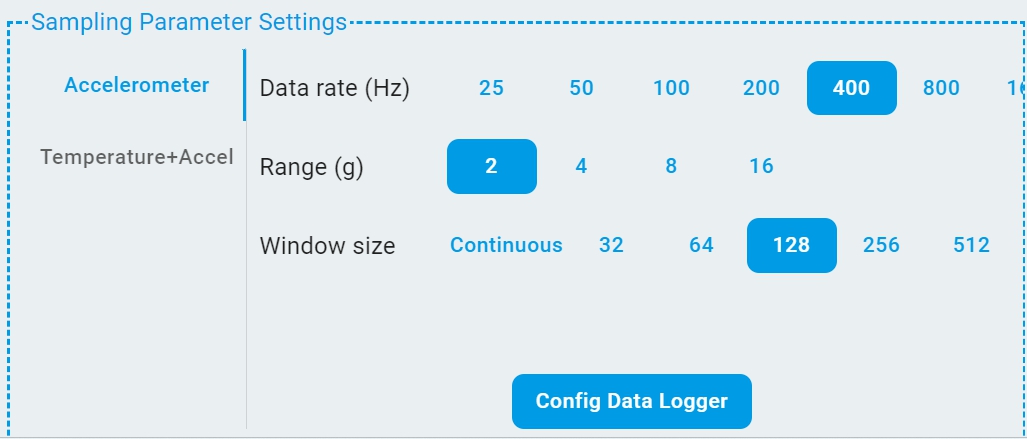 Remark: To enable continuous data collection, select
 Continuous in the Window size parameter.
Dataset Settings
It is supported in the third step.

Specify the number of classes and number of channels of the dataset depending on your application. Confirm settings by clicking the √ button on the right.
Collect Dataset:
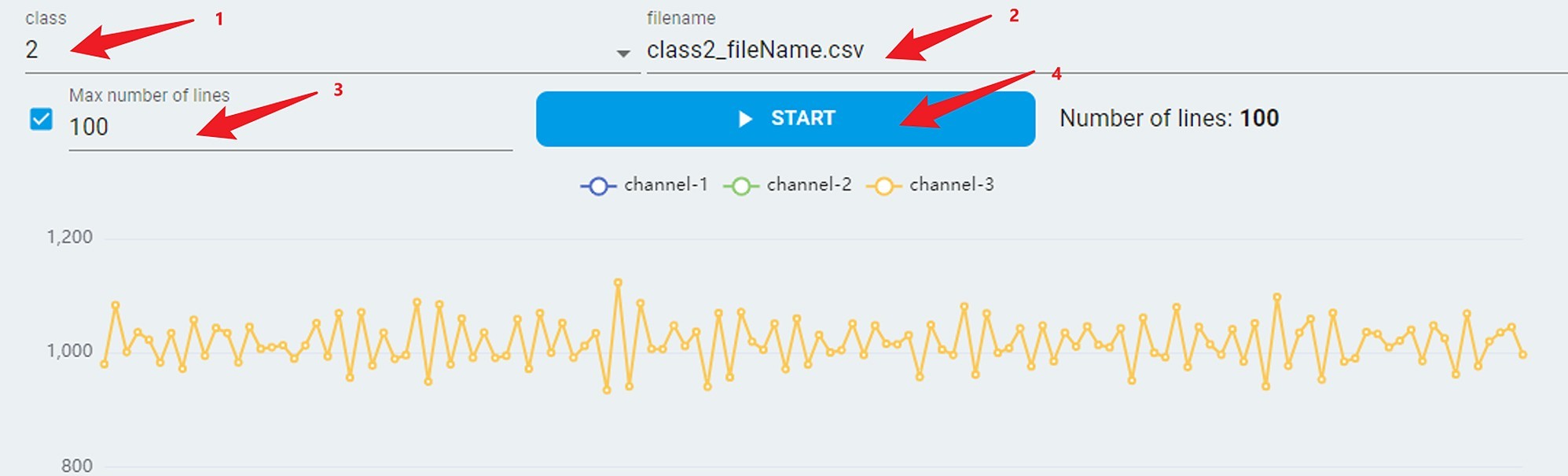
Select a target class for the dataset to be collected.
Customize a filename for the file to be saved.
Check the
max number of linescheckbox and specify the desired sample line count. Alternatively, use the default value of 100 lines.Click the
STARTbutton, the real stream data appears and auto saves in the file with maximum lines. However, for boards not in theYour Targetsupport list, ensure that the board is already sending sensor data.Repeat the above four steps to collect all datasets by selecting different target classes.
To open the folder with the saved dataset file, click the Open Saved Dataset button.